Dapia
The heart of town — its name means “fortification.” Historic cannons still point seaward from the old gun emplacements, cafés line the front, and the carriages, bicycles, and water taxis give it its car-free bustle. Where the ferries arrive.
History, geography, and the island of The Magus
A small, pine-covered island in the Saronic Gulf — close enough to Athens for a weekend, yet rich enough in history to reward a lifetime of return visits. The first Greek island to rise in the 1821 revolution; home to one of history's only female admirals; and, in the early 1950s, the model for the haunted, labyrinthine island of John Fowles's The Magus.
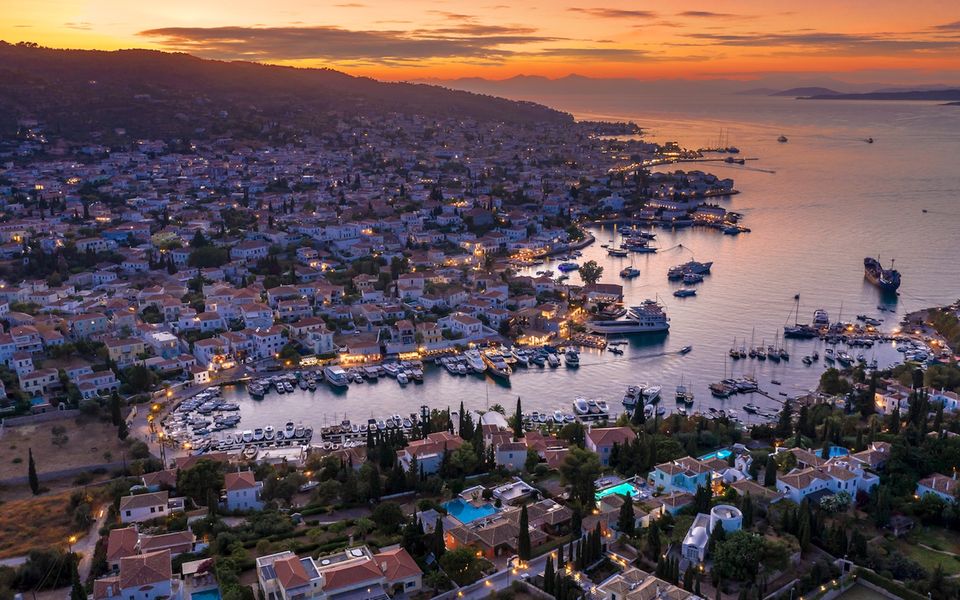
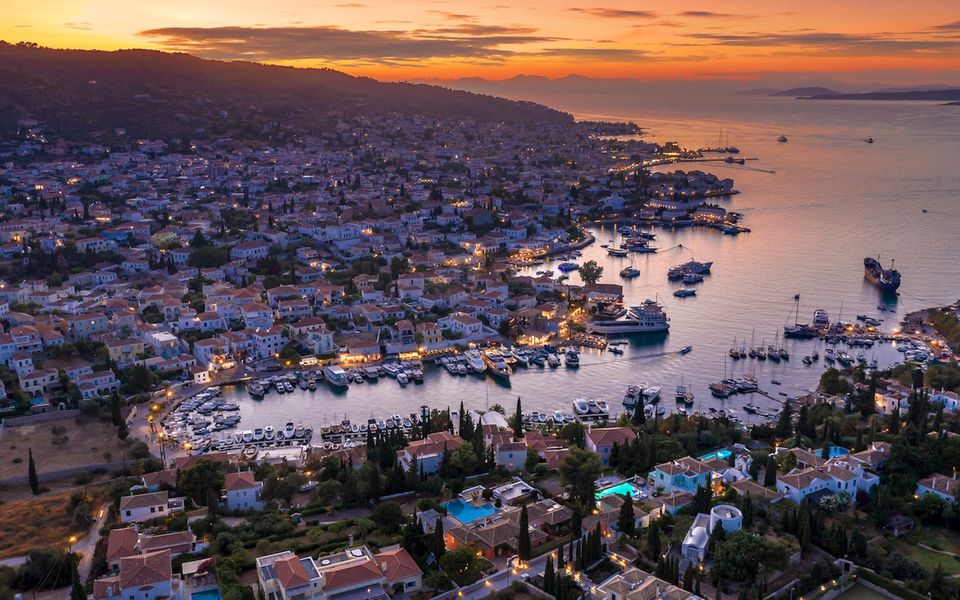
The southwesternmost of the Saronic islands, Spetses sits in the Myrtoan Sea barely two kilometres off the mainland at Kosta — reached directly from Piraeus on the same fast boats that serve glamorous Hydra.
Tap any marker for the story behind it — the harbours and sights, the beaches and coves, and the places that became Fowles's Phraxos. Toggle a category, or trace the half-day Magus literary loop.
Spetses wears its wealth quietly and keeps its history close to the surface. For a speck of pine and pebble barely larger than a city, it has carried an outsized weight of consequence — a maritime fortune, a war of independence, a belle-époque revival, and a novelist's enchanted island all overlapping on the same few square kilometres.
The island has been inhabited for more than four thousand years. Archaeological finds reach back to the Early Bronze Age, around 2500–2300 BC, and by the Mycenaean period it was already known as Pityoussa — “the pine-covered.” Its position in the Saronic Gulf made it a natural waypoint, and for centuries it served as a modest commercial and trading post.
It passed, like most of the Aegean, through Roman and Byzantine hands with little to mark it out. The decisive change came under the Venetians, who called it Isola di Spezie, the island of fragrances or spices — almost certainly for its resinous Aleppo pine and the wild herbs that scent the air. The modern name descends directly from that Venetian one.
For much of the Middle Ages the island was too exposed to corsairs to support a settled population. The first lasting settlement, Kastelli, grew on the northwest side, and permanent villages only really took hold in the 1600s, swelled by families crossing from the Peloponnesian coast. As on neighbouring Hydra, many were Arvanites — Albanian-speaking Orthodox Christians — who brought a seafaring culture that would soon make the island rich.
The 1700s were Spetses' golden age. From around 1750, Spetsiot shipowners built a powerful merchant fleet that ran grain from the Black Sea granaries of Russia and Romania to the markets of Italy, France, and Spain. The Russo-Turkish treaty of Küçük Kaynarca in 1774 let Greek vessels sail under the protection of the Russian flag, and the long Napoleonic Wars made blockade-running enormously profitable for fast, well-armed neutral ships.
There was a problem the islanders turned into a strength. Greece had no navy to protect its merchantmen from Barbary and Maltese pirates — so the shipowners built vessels that could carry both cargo and cannon. The boatyards of Spetses produced an armed merchant fleet that, when the moment came, could fight. That wealth is still written along the waterfront in the two-hundred-year-old captains' mansions, the archontika, and in the great shipowning names: Mexis, Botasis, Goudis.
“Spetses was the first island to raise the revolutionary flag, on 3 April 1821 — soon followed by Hydra and Psara.” The War of Independence
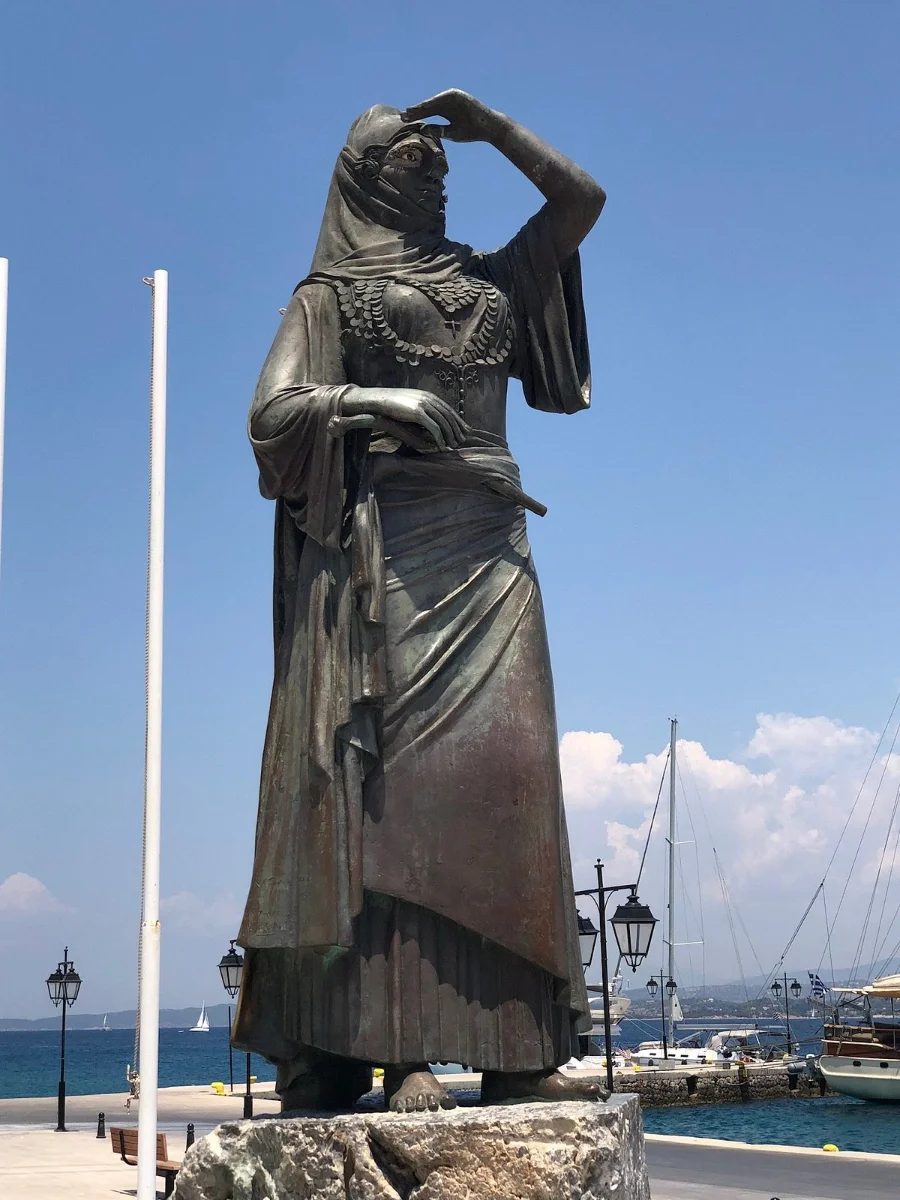
When the Greek War of Independence broke out, Spetses threw its armed fleet — some sixty ships — into the struggle, and Spetsiot captains became known across Europe for their daring. The island's defining figure is Laskarina Bouboulina (1771–1825). Born, by tradition, in a Constantinople prison where her mother was visiting her imprisoned father, twice widowed, she inherited and expanded a substantial shipping fortune and used it to build and arm ships — the largest of them the corvette Agamemnon, among the biggest warships in the Greek fleet.
She took her ships into the war herself, helping blockade and besiege the Ottoman strongholds of the Peloponnese, including Nafplio and Monemvasia. The Russian Tsar Alexander I is said to have honoured her with the rank of admiral — often remembered as the only woman in naval history to have held it. Her end came not at sea but at home: she was shot dead on Spetses in 1825, caught in a bitter family vendetta. Her three-hundred-year-old mansion is now the island's most-visited museum.
The island's proudest day is 8 September 1822, when an Ottoman fleet sailing to crush the revolution in the Peloponnese was met and turned back in the straits between Spetses and the mainland. Fireships and bold manoeuvring broke the attack. The victory is bound up with the feast of the Nativity of the Virgin, and is re-enacted every September as the Armata — the island's great festival, complete with a burning replica of an Ottoman flagship and fireworks over the harbour. The church of Panagia Armata was raised in thanksgiving.
After independence in 1830 the island lost its wartime purpose and slid into decline. Its revival was largely the achievement of one man. Sotirios Anargyros, born on Spetses in 1849, emigrated to the United States and made a fortune in tobacco, then returned determined to remake his homeland. He financed the reforestation that restored the pine cover the island is named for; in 1904 he built his extraordinary mansion, Neith, guarded by Egyptian sphinxes; in 1914 he opened the Poseidonion Grand Hotel, modelled on the grand hotels of the French Riviera; and in the 1920s, with Marinos Korgialenios, he founded the boys' boarding school that would later become Fowles's “Lord Byron School.”
By the 1960s and 70s, Spetses had settled into the role it still plays: a fashionable but understated retreat for Athenians and foreign visitors, car-free in the town, busy through the season with weddings, regattas, and festivals. It wears its history lightly, and well.
Bronze-Age settlement; the island is already “the pine-covered.”
Arvanite families cross from the Peloponnese and settle for good.
An armed merchant fleet runs Black Sea grain across the Mediterranean.
Spetses is the first Greek island to raise the revolutionary banner.
The Ottoman fleet is turned back in the straits — now the Armata festival.
The admiral-heroine dies at home in a family vendetta.
Neith, the Poseidonion, reforestation, and the great boarding school.
Two years at the school seed the novel The Magus (published 1965).
An oval island of about 22.5 square kilometres, the southwesternmost of the Saronic group, sitting where the Saronic Gulf opens toward the Argolic.
The centre is low rolling hills cloaked in Aleppo pine — the Pityoussa of antiquity — much of it replanted in the twentieth century under Anargyros. Mixed through the pine are pistachio, olive, fig, oleander, and cypress, and in places the forest runs right down to the sea. The highest point is Profítis Ilías, around 290 metres, near the centre; footpaths climb to the summit, and from the top the view runs north to Kosta and the Didyma mountains, and south across the gulf toward Leonidio.
The coast is mostly pebble and shingle, broken by rocky swimming coves, with a single stretch of true sand reachable only by boat. A paved road of roughly twenty-six kilometres rings the island — which is why a bicycle or scooter is the natural way to explore it. The island has very little fresh water of its own; for much of its modern history its needs have been met by a water-carrier boat that makes a daily run from the mainland and unloads at Dapia.
Just off the southeast coast lies the small private islet of Spetsopoúla, about two square kilometres. The shipping magnate Stavros Niarchos bought it in 1962 and turned it into a famous private retreat, complete with a beach protected by a shark net. It remains in the family and cannot be visited.
The climate is classic Mediterranean — hot, dry summers, mild wetter winters. June and September are the sweet spots: warm and bright, the sea already (or still) swimming-warm, the island lively without the August crush. Late June runs to daytime highs in the low 30s °C with a sea around 23–24 °C.
The heart of town — its name means “fortification.” Historic cannons still point seaward from the old gun emplacements, cafés line the front, and the carriages, bicycles, and water taxis give it its car-free bustle. Where the ferries arrive.
The belle-époque landmark on Dapia, beautifully restored and still the island's social anchor, its seafront facade inspired by the hotels of the French Riviera. The bronze statue of Bouboulina stands on the square outside.
The house a step behind the harbour, flanked by two Egyptian sphinxes — a monument to the island's modern benefactor and one of the strangest, most memorable buildings in the Saronic.
The island's first port — prettier and quieter than Dapia, lined with neoclassical mansions. Its boatyards (tarsanades) still build and repair wooden hulls by hand. The place to be at dusk.
The heroine's three-hundred-year-old mansion, shown by guided tour, with her personal belongings and weapons — and a remarkable carved wooden ceiling in the main salon.
In the 18th-century Mexis mansion. A room devoted to the War of Independence holds the revolutionary flag, Bouboulina's ossuary, historic weapons, and carved ships' figureheads.
At Agios Nikolaos, with religious artifacts and a beautiful pebble-mosaic courtyard that also hosts exhibitions and events.
Where the revolutionary flag was first raised in 1821. By local legend, the embalmed body of a nephew of Napoleon was once kept here in a cask of spirits.
The church near the Old Harbour built to commemorate the naval victory of 8 September 1822, home to a large painting of the battle.
At the entrance to the Old Harbour — one of the early lighthouses of independent Greece, a quiet and atmospheric corner with the church of Panagia beside it.
The site of the island's oldest settlement, on higher ground, with old churches and a sense of the pre-modern village.
The grand neoclassical boarding school on the west side of town — the model for the school in The Magus. The exterior reads clearly; interior by arrangement with the foundation.
Most beaches are pebble or shingle, with clear water and, often, pine shade. The ring road and water taxis make them all reachable.
A large south-coast bay with a taverna, sunbeds, and watersports. At its far end is the Bekiris Cave, a wartime hideout reached by a short swim or scramble.
A quieter, sheltered cove just west — golden sand and gravel, pine to the water, a small bar, no toilets. Central to The Magus.
A pine-fringed double cove on the northwest side, for many the most beautiful on the island, with a simple taverna. The final approach is a rough track.
A lively, popular beach on the west side with a beach bar — an easy ring-road stop.
A quieter pebble beach on the south side, good for finding some space.
Organized and easy, for a quick swim without going far. Kaiki, near the school, draws a younger crowd to its beach bar.
The best tables cluster in two places: the Old Harbour to the east, and the Kounoupitsa waterfront in town. This is not a cheap island, and whole fish is sold by weight — so ask the price before you order, and in high season book a day ahead for the well-known places.
Fish baked with tomato and breadcrumbs — a recipe that originated on the island and still defines its table.
Lobster with spaghetti — the celebratory dish of the harbourside fish tavernas.
Local almond sweets — the traditional close to a Spetsiot meal, and a good thing to carry home.
The island benchmark for seafood, run by the Kaloskamis family from their own fishing boats. Pebbled tables at the water's edge among the old boatyards; ceviche and the day's catch are the move.
Set in a restored 200-year-old olive press, with candlelit tables on its own pier and a Mediterranean menu with Asian touches. The most atmospheric dinner on the island, and priced for it.
In the whitewashed building that was the island's first port authority (1802), between Dapia and the Old Harbour — known for black squid-ink risotto and daily specials.
A seaside fish taverna with tables right over the water — strong on fresh fish, fish soup, and astakomakaronada. Lively and popular, so go earlier for a quieter table.
A friendly, family-run taverna with tables on the pebbles; excellent fresh seafood and notably good value by local standards. Let one of the brothers steer your order.
Tarsanas's sister restaurant — the same fish pedigree in a slightly more relaxed seaside setting.
The restaurant of the Poseidonion Grand Hotel — the island's most refined kitchen. Modern Greek in a grand belle-époque setting, with vegetarian and gluten-free options.
Argiris for a dependable traditional taverna; Provenza (Italian) and La Esquina (tex-mex / tapas) for a change of pace. Quarter Pizzeria on the Clock Tower square is the cheerful local favourite, and Roússos the go-to all-day café for breakfast and coffee.
An elegant rather than rowdy scene, and the geography is simple: it starts in town and builds eastward to the Old Harbour, where the louder bars and clubs run late.
A small, characterful place lined with vintage Dylan and Woodstock posters, hundreds of spirits behind the bar, and old soul and rock on the speakers. Order a brandy sour and stay for one more — the quintessential first drink of the night.
The smart choice for a properly made cocktail in belle-époque surroundings, open late.
Votsalo, Mayo, Balconi, and the long-running Stavento and Bratsera for cocktails along the front.
Bikini is the standout cocktail bar (ask for a Spetses Spritz), with Throubi for a relaxed harbour-view drink. The late venues — Guzel, La Luz, Nuovo 1800, Marine — keep going toward sunrise.
Daytime-into-evening DJ sets, if you want a beach-club afternoon.
There is no airport on Spetses, and because the town is car-free, no car ferries serve it — every crossing is on a fast passenger boat.
High-speed catamarans only — Hellenic Seaways / Blue Star (the Flyingcat boats), Alpha Lines, and Magic Sea Ferries. Direct sailings run 1h45–2h; some stop at Poros and Hydra first and take 3h+, so check yours is direct. Fares ≈ €45–60 one way, seats assigned, up to ten departures a day in summer, from Gate E8.
Metro Line 3 runs directly from the airport to Piraeus (about an hour); a fixed-fare taxi is roughly €40–55; the X96 express bus is the budget option but slower.
Drive down the Peloponnese to the little port of Kosta (≈ 2.5h from Athens), leave the car, and cross by water taxi in about ten minutes. The option to choose if you want a car on the mainland for the Argolid.
Private cars are banned in the main town, which is part of the island's charm. You move by foot and bicycle — the flat coastal promenade is a pleasure to walk or cycle — and by scooter, ATV, or buggy, rented locally, which is the ideal tool for covering the ~26 km ring road and reaching the southern and western beaches. Motorbike-taxis and the horse carriages (fiacres) get you around town; the carriages are a lovely once-a-trip experience. Water taxis run to the beaches on demand from the Dapia rank — not cheap, and priced per trip rather than per person, so agree the price before you set off. A small bus serves some beaches, including Agia Paraskevi, on a set timetable.
Helmets are mandatory and actively enforced, with on-the-spot fines — the rental supplies one, so wear it. Bring both your home licence and an International Driving Permit: Greece has announced a 2026 crackdown on quad-bike rentals, so expect a proper licence check at pickup. Keep off the pedestrian lanes of the old town (heavy fines), never ride after drinking, and take the descents to the beaches gently — the surface turns loose and gravelly, and some stretches are narrow with blind bends.
Cards are accepted almost everywhere — businesses are legally required to take them — but carry some cash for water taxis, kiosks, and tips. Use bank ATMs (Piraeus, Alpha, National, Eurobank) rather than the standalone Euronet machines, which carry poor rates and high fees.
4G/5G is good in town and along the coast, patchier in the pine interior. From outside the EU, a travel eSIM (Airalo, Saily, Holafly) bought before you fly is simplest, or a local Cosmote / Vodafone / Nova SIM for best island coverage. Within the EU, your own plan should roam free.
Not obligatory and never large — rounding up the bill or leaving 5–10% in cash for good service is generous and appreciated. The currency is the euro.
The island's great festival, marking the 1822 naval victory with a re-enacted sea battle, a burning mock flagship, and fireworks. The single most spectacular night of the Spetses year.
A regatta of classic and traditional sailing boats.
A triathlon and a running event that bring athletes to the island after the summer heat.
The old town runs on a gentle, walkable rhythm — move at its pace, give way to the carriages, and keep scooters to the roads rather than the pedestrian lanes. Dress is smart-casual in the evenings rather than formal. Because the island's fresh water arrives by boat, it's a place to be mindful of waste.
“Spetses is the Phraxos of John Fowles's labyrinthine novel — and you can still walk into it.”
In 1951 a young Oxford graduate named John Fowles took a post teaching English at the Anargyrios and Korgialenios School. He stayed until 1953, when he and the other masters were dismissed after trying to reform the place. Fowles found the school stifling but the island intoxicating — and it was here, too, that he met Elizabeth Christy, who would become his wife. Out of those two years grew the novel that would make his name. He had a choice, as he put it, between a safe post in England and “a ratty school in Greece,” and went, against all common sense, to Greece.
The Magus was the first book Fowles wrote, though the third he published, after The Collector (1963) and The Aristos (1964). He began it in the 1950s under the working title The Godgame, worked at it for some twelve years, published it in 1965, and reworked it substantially for a revised edition in 1977.
Nicholas Urfe, a bored and rootless young Englishman, takes a teaching job at the “Lord Byron School” on the fictional island of Phraxos. Lonely and adrift, having abandoned a relationship with an Australian woman named Alison, he wanders the island and falls into the orbit of Maurice Conchis, a wealthy, enigmatic recluse at a clifftop villa called Bourani. Conchis draws him into an elaborate, ever-shifting psychological game — staged like a private theatre in which masque, myth, hypnosis, and outright deception blur the line between the real and the invented. Nicholas can never be certain what is true, and neither, for long stretches, can the reader.
Beneath the mystery, The Magus is a novel of ideas. Its central conceit — which Fowles called the “godgame” — is the spectacle of a man playing god with another's perception of reality, never explaining, always one move ahead. Its great themes are freedom and choice, the cost of self-knowledge, and the lure of the lost enchanted realm, the “domaine,” an idea Fowles took from Alain-Fournier's Le Grand Meaulnes. Among Conchis's tales is a moral set piece set during the German occupation of Greece — a man forced into an impossible choice about freedom and violence — one of the book's darkest and most discussed passages. The influences run from Jung and the tarot to Greek myth, the commedia dell'arte masque, and Great Expectations.
| In the novel | On the island |
|---|---|
| Phraxos, the island | Spetses itself |
| The Lord Byron School | The Anargyrios & Korgialenios School, named for Byron, who died supporting Greek independence |
| Bourani, Conchis's villa | A real house on the south coast, in the pines above Agia Paraskevi |
| The chapel and the recurring beach | The church and beach of Agia Paraskevi |
| The pine forest and the sense of isolation | The wild southern and southwestern half of the island |

Fowles composited and invented freely, and pilgrims who go looking for the villa often fail to find it at all. Local tradition still points to a real house in the pines above Agia Paraskevi, identified variously as Villa Jasemia (sometimes Giacemia) or the Botassi villa. Treat it as inspiration and lore rather than a fixed address — Phraxos is a transfigured Spetses, not a literal map of it.
Fowles describes Phraxos as effortlessly, rarely beautiful — its hills feathered with light Mediterranean pines, a beauty unusual even for the Aegean. The 1968 film, with Michael Caine, Anthony Quinn, Candice Bergen, and Anna Karina, is notorious as one of cinema's great misfires — and, fittingly for a story about illusion, it was not even shot on Spetses but on Mallorca. Woody Allen famously joked that the one thing he would change about his life is that he would not have sat through it.
If you're returning to the book before the trip, carry the 1977 revised edition. Fowles reworked the prose, and his foreword discusses the novel's origins and his refusal to resolve the ending — which he leaves suspended on a Latin couplet from the Pervigilium Veneris: roughly, let whoever has never loved love tomorrow, and let whoever has loved love tomorrow too. It is the closest thing to an answer he will give, and perfectly in keeping with a book about being left in not-knowing.
About four to five hours by scooter or ATV, tracing the island of The Magus from the school to the Phraxos coast and back — west and south out of town, down to the literary beaches, and home through the pines. Trace it on the map ↑
Rent and fill the tank near Dapia — the ring road has few services. Ride the beach stretch in the cooler morning, then linger over the swim. Carry water and sun protection (Agia Paraskevi has no toilet; sunbeds run about €15 a pair, though the pines give free shade). And bring the book.
Begin with a coffee on the waterfront — the harbour where Nicholas, and Fowles before him, stepped off the boat onto the island. Get your bearings among the cannons and carriages, then point the scooter west.
In the book — Urfe's first, disoriented arrival on Phraxos.
The school itself, model for the institution Urfe is so desperate to escape. Walk the grounds and take in the great neoclassical facade; picture the suffocating boarding school Fowles loathed and fictionalised. The building reads clearly from outside.
In the book — the school where Nicholas teaches and despairs.
Follow the coast road as it climbs into the pine forest, the inhabited north dropping behind. This is the closest thing to entering the enchanted, cut-off world of the novel. Pull over at a high turnout, cut the engine, and let the silence and the smell of pine settle. A side path toward Profítis Ilías offers an optional summit view.
In the book — the solitary walks that draw Nicholas toward Conchis's world.
The literary centre of the whole trip: the small whitewashed chapel of a pivotal scene, the beach that recurs throughout the book, and — in the pines above — the villa local lore calls the real Bourani. Swim in the clear water, read a few pages in the shade, and look up into the trees.
In the book — the chapel scene and the approach to Bourani.
A short hop east to the larger bay. Swim out, or scramble along the rocks at the far end, to the Bekiris sea cave — a genuine wartime hideout that suits the novel's world of hidden rooms, masks, and concealment.
In the book — the motif of secrecy, discovery, and what lies just out of sight.
Loop home, or continue the full ring-road circuit. For a coda, end the day at the Old Harbour as the light goes — watching the boatyards and the water, the quiet return from Phraxos to the ordinary world.
In the book — Nicholas's long road back toward reality.
The Old Harbour boatyards at any hour, a fitting Magus-adjacent stop. Profítis Ilías by an inland footpath, for the island's best panorama and a sense of how small and self-contained Phraxos really is. And a second swim at Zogeria on the northwest side if you ride the full ring road — arguably the prettiest cove on the island.
A long weekend fills up quickly, so the windows for striking out can be slim. These run from what fits a few spare hours to what wants a whole free day — match the outing to the time you actually have.
Boats and RIBs hire from Dapia, and skippered trips circle the island to coves you can't reach by ATV, with stops to swim and snorkel. The prettiest target is Zogeria; Dokos, the uninhabited islet toward Hydra (site of one of the oldest known shipwrecks), is a favourite slightly further out.
The ~26 km circuit is a half-day in itself. The Magus Loop is the richest version, but even a straight ride around the island — stopping to swim at Agia Paraskevi, Agioi Anargyroi, or Zogeria — is a perfect early-morning escape before the heat.
A water taxi crosses to the mainland at Kosta in about ten minutes; a little further sits Porto Cheli, an upscale resort town sometimes called the “Greek Hamptons” — good for a meal, a marina wander, or a quieter beach. Easy and low-commitment.
Spetses's glamorous neighbour, reachable on the same high-speed boats — equally car-free (donkeys and water taxis only), an exquisite stone harbour-town, art galleries, cliff-jumping swim spots, and superb people-watching. Check the return times carefully: a missed last boat means an unplanned night away.
Some of Greece's greatest sights: Nafplio, arguably the country's most beautiful town; the perfect ancient theatre of Epidaurus; the Bronze-Age citadel of Mycenae. Logistically heavy — cross to Kosta, then a hire car (Nafplio is 1.5–2 h) — so it suits a dedicated day. A private skippered yacht to Nafplio, with a swim stop, is an easier, pricier alternative.
A Friday-evening drink at Bar Spetsa and dinner at the Old Harbour; a dawn ATV run to Agia Paraskevi for a quiet swim before the day warms up; and a last coffee on the Dapia waterfront before the ferry. That alone is a proper taste of the island.